Reading time: 15 minutes
Writing time: 2 hours and 30 minutes
Section A
40 marks.
Question 1
A single stranded nucleic acid was found in the nucleus of a cell, containing exons only. The monomer of this strand would contain
- deoxyribose sugar, phosphate group and nitrogenous bases
- ribose sugar, phosphate group and nitrogenous bases
- an amine group and a carboxyl group
- glucose
Question 2
NADPH is
- loaded, transporting protons from the stroma to the grana
- loaded, transporting protons from the matrix to the cristae
- loaded, transporting protons from the light dependent to the light independent stage of photosynthesis
- loaded, transporting protons from glycolysis to the Krebs cycle
Question 3
Polymerase Chain Reaction is a DNA manipulation tool used to amplify small samples of DNA. A double strand of DNA was placed into a PCR machine. How many strands would there be after 5 cycles?
- 5
- 10
- 32
- 64
Question 4
The promotor region of a gene is the location where
- the operator binds to
- RNA polymerase binds to
- the repressor protein binds to
- where regulatory factors are produced
Question 5
Following transcription, pre-mRNA is formed. Before pre-mRNA can leave the nucleus, post transcriptional modification must occur. This included
- addition of a methyl cap at the 3’ end
- addition of a poly A tail at the 5’ end
- removal of introns
- removal of exons
Question 6
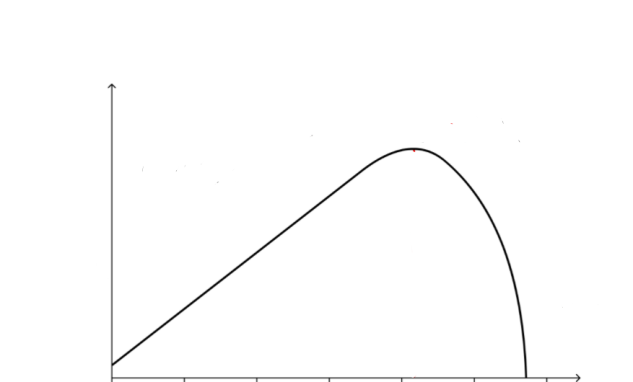
A student conducted an experiment investigating factors that affect the rate of photosynthesis. They produced the following graph, but forgot to label the axis. The most likely labels would be
- x axis: pH; y axis: rate of reaction
- x axis: temperature; y axis: rate of reaction
- x axis: rate of reaction; y axis: pH
- x axis: rate of reaction; y axis: temperature
Question 7
Carbon fixation occurs only once in
- C3 plants
- C4 plants
- CAM plants
- all plants
Question 8
For a science experiment, a student wanted to identify the best source of biomass for fermentation. They decided to compare corn, wood filings and hay. They placed equal amounts of each material in a beaker with sugar and water and observed the results.
After 10 minutes, they realised that they had not sealed the beaker, therefore had been unable to measure the volume of gas produced. This is an example of a
- systematic error
- random error
- human error
- experimental error
Question 9
Antigen presenting cells are an integral component of the adaptive immune system. They play a key role in detecting foreign pathogens that have entered the body. All antigen presenting cells have
- MHC I markers
- MHC II markers
- no nucleus
- auto antibodies
Question 10
When comparing memory B cells and plasma cells
- memory cells release free antibodies and an extensive network of endoplasmic reticulum
- plasma cells release free antibodies and an extensive network of endoplasmic reticulum
- memory cells have attached antibodies and an extensive network of endoplasmic reticulum
- plasma cells have attached antibodies and an extensive network of Golgi complex
Question 11
A set of 100 mitochondria were separated from the cell and placed in a watery medium. They were placed in a water bath and heated to 80oC, before being cooled to 15oC.
Pyruvate and oxygen were added to the solution, and the rate of reaction was measured. It would be expected that the rate of reaction would
- increase
- decrease
- stay the same
- increase and then decrease
Question 12
CRISPR-Cas9 can be used to modify the genome of Rubisco, increasing its affinity to carbon dioxide over oxygen. This improves photosynthetic affinity as
- oxygen cannot act as a non-competitive inhibitor to carbon dioxide
- carbon dioxide is required for the light dependent reaction to occur
- carbon dioxide is required for the light independent reaction
- more atmospheric oxygen is available for cellular respiration
Question 13
An experiment was conducted to identify the optimum temperature for the enzyme amylase. 3mL of amylase was added to 10mL of starch solution, and 3 drops of iodine. The colour change was recorded over three trials.
What type of data has been collected in this experiment?
- quantitative
- continuous
- erroneous
- qualitative
Question 14
A bacterial cell breached the first line of defence and started to multiply within the body. Prior to the adaptive response, which of the following is most likely to occur?
- infected cells release interferon
- T helper cells release cytokines to stimulate clonal expansion of cytotoxic T cells
- complement proteins coat the bacteria to prevent binary fission
- natural killer cells stimulate apoptosis of bacterial cells
Question 15
The following information relates to Questions 15 and 16
During extreme weather events, pollen can be drawn up into clouds within the atmosphere. When the clouds break, during a storm, the pollen is broken into smaller fragments dispersing in the air.
On the first exposure to the pollen, what occurs in individuals who will become allergic to pollen?
- mast cells release histamine
- complement proteins agglutinate pathogens
- IgE antibodies bind to mast cells
- macrophages engulf the pollen fragments and destroy them
Question 16
On the second exposure to pollen, what occurs in individuals who are allergic to pollen?
- pollen binds to antibodies on the mast cells, causing them to degranulate
- pollen binds to MHCII markers on dendritic cells
- pollen is engulfed by macrophages, causing symptoms of hay fever as a result
- pollen is destroyed by T helper cells
Question 17
50 million years ago, ancestral whale populations were land dwelling and had hoofs. To support their terrestrial lifestyle, they had a pelvis for attachment of the femur. To this day, the remnants of this pelvis remain in the whale skeleton.
The pelvis is an example of a
- homologous structure
- analogous structure
- vestigial structure
- non-functional structure
Question 18
Ross River fever is a mosquito borne virus, caused by the Ross River virus. Sufferers have flu- like symptoms, including muscle aches and fatigue. Local governments in northern Queensland aimed to inform tourists to the area of the risks of Ross River fever.
Which of the following is suitable advice?
- always stay indoors
- leave all windows open to stimulate air flow
- use insect repellent
- take anti-malaria tablets prior to your holiday
Question 19
The following diagram shows a sequence of pre-mRNA. The white regions code for introns, with the black regions coding for exons. W is white, B is black. WBBWBWW
During transcription, a mutation occurred with the nitrogenous base uracil being substituted for a guanine in the white region.
The effect on the protein product:
- would be minimal as it is a single base change
- is unable to be determined, as it may create a nonsense mutation
- would have no effect
- would create a non-functional protein
Question 20
Which of the following are characteristics of some primates but not any hominoids?
- stereoscopic vision
- opposable thumbs
- 5 digits on each hand
- presence of a tail
Question 21
The DNA of 3 species underwent DNA hybridisation.
Species A and B had a melting temperature of 70C
Species A and C had a melting temperature of 62C
Species B and C had a melting temperature of 68C
It is reasonable to conclude that
- species B is more related to species C than A
- species C is more related to species A than B
- species A is more related to species C than B
- species B is more related to species A than C
Question 22
The following information refers to Questions 22 – 24
Four students conducted an experiment. They added 2mL of lipase, 5mL of full fat milk, 5mL of sodium carbonate solution and 5 drops of pH indicator. They recorded the time it took for a solution to change from neutral to acidic, as evident by colour change. The expected time was 55 seconds.
Their data is shown in the table below:
| Student | Trial 1 (secs) | Trial 2 (secs) | Trial 3 (secs) |
|---|---|---|---|
| Ally | 35 | 42 | 34 |
| Ben | 55 | 57 | 56 |
| Cahil | 43 | 58 | 55 |
| Daanish | 34 | 57 | 45 |
Which student had the most precise data?
- Ally
- Ben
- Cahil
- Daanish
Question 23
Which student had the most accurate data?
- Ally
- Ben
- Cahil
- Daanish
Question 24
Daanish conducted an additional trial. This time he decided to add in 4mL of lipase. The fourth measurement would be
- faster than measurements 1-3
- slower than measurements 1-3
- within the same range as measurements 1-3
- unaffected by the change
Question 25
The correct sequence of steps in polymerase chain reaction is
- reception, transduction, response
- denaturation, elongation, annealing
- denaturation, annealing, elongation
- elongation, annealing, denaturation
Question 26
Individuals have unique mutations in their mtDNA. Individuals with the same mutation belong to the same haplogroup. As such, haplogroups can be used to determine relatedness between groups. It has been found that the most variation in mtDNA haplogroups is found in African populations. This information
- supports the multiregional hypothesis
- supports the Out of Africa hypothesis
- provides evidence of interbreeding between African and Neanderthal populations
- provides evidence of ancestral African populations living in social groups
Question 27
Monoclonal antibodies can be used to treat cancer. One method is to attach a drug to the antibody to directly target cancerous cells. One constraint of monoclonal antibodies in the treatment of cancer is that
- other cells in the vicinity of the cancerous cells will be affected with the drug
- cancerous cells may mutate, altering the surface antigens
- the attached drugs may have other adverse health effects
- the immune system is stimulated, causing similar symptoms to that of an allergic reaction
Question 28
The following information relates to Questions 28 and 29
The Northern corroboree frog is found in forests and sub-alpine woodlands in NSW. It is at risk of extinction due to the presence of a fungal disease that is fatal. As with any wild animal, they are also subject to potential habitat loss and predation from other species.
The Melbourne Zoo has released fertile eggs originating from a breeding pair at the zoo into their natural habitat to try and increase the population.
The eggs released would be expected to have:
- more genetic diversity than the wild population, therefore at greater risk of extinction
- less genetic diversity than the wild population, therefore at decreased risk of extinction
- more genetic diversity than the wild population, therefore at decreased risk of extinction
- less genetic diversity than the wild population, therefore at greater risk of extinction
Question 29
A local conservation group wished to treat frogs affected with the fungal disease. They created small boxes to catch the frogs where they could treat them before releasing them back into the wild. What would be the most effective form of treatment?
- antibiotic drugs
- antiviral drugs
- antimicrobial spray
- insect repellent
Question 30
The trp operon regulates production of the amino acid tryptophan in E. coli. This amino acid is essential for protein synthesis to occur in E. coli. When tryptophan is present in the environment of E. coli, transcription of the structural genes is not required. To prevent transcription
- the trp repressor binds to the trpR, preventing transcription from occurring
- the trp repressor binds to the promoter region, preventing transcription from occurring
- the trp repressor binds to RNA polymerase, preventing it from catalysing addition of free nucleotides to form mRNA
- the trp repressor binds to the operator region, preventing RNA polymerase from catalysing the addition of free nucleotides to form mRNA
Question 31
The following information relates to Questions 31 and 32
A fossilised shell was found covered by minerals in a cave that was once believed to have been below water. Mineral deposits found above the shell were radioactively dated and found to be 30,000 years old.
The shell would be:
- younger than 30,000 years
- older than 30,000 years
- 30,000 years old
- there is insufficient evidence to determine the exact age of the shell
Question 32
The most appropriate method for finding the absolute age of the minerals covering the shell would be:
- potassium argon dating
- carbon nitrogen dating
- uranium dating
- law of superposition
Question 33
Due to the universal nature of DNA, genes can be inserted into organisms from different species. If the transformation is successful, the organism receiving the DNA can produce the functional protein for which the gene encodes.
An organism containing foreign DNA is described as
- only genetically modified
- only transgenic
- genetically modified and transgenic
- transformed
Question 34
B and T lymphocytes play an integral role in third line of defence. Which of the following is true for B and T lymphocytes?
- both B and T lymphocytes are activated by dendritic cells
- both B and T lymphocytes are produced and mature in the bone marrow
- B and T lymphocytes are produced in the bone marrow
- B and T lymphocytes are used in the innate response
Question 35
Characteristics of inflammation include:
- leaky capillaries
- drop in temperature
- vasoconstriction
- swollen lymph nodes
Question 36
Hominins are classified as:
- all Homo genus and their primate ancestors
- all Homo genus and their mammalian ancestors
- all Homo genus and their hominoid ancestors
- all Homo genus and their bipedal ancestors
Question 37
The Lord Howe Island palms diverged into separate species despite there being no geographical barrier between them. This form of speciation is referred to as
- sympatric
- allopatric
- natural selection
- founder effect
Question 38
The industrial revolution altered the environment of the peppered moth in the United Kingdom. Prior to the industrial revolution, buildings were generally white. Following the industrial revolution, soot from the factories covered buildings, creating a darker environment. The change in colour of the buildings provided darker moths with
- a selective pressure
- a selective advantage
- a novel phenotype
- a new environment
Question 39
One benefit of herd immunity is that
- pathogens have reduced spread within populations
- pathogens have less hosts to reproduce in
- the very old and very young are protected
- all the above
Question 40
Which of the following is an example of a chemical defence in plants?
- waxy cuticle
- production of phenol acid
- presence of sap
- production of resin
Section B
80 marks.
Question 1
Antibodies are produced in the third line of defence. They play an integral role in agglutinating pathogens to protect the body from infection.
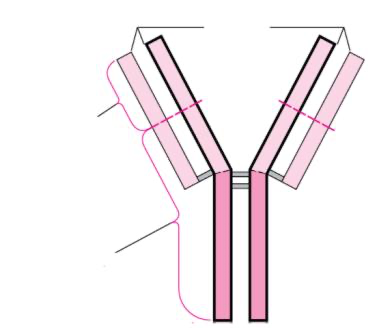
- The diagram above shows an antibody. What macromolecule is an antibody composed of? ]]1
- Label the 3 regions of the antibody above. ]]1
- Describe the process that occurs within the nucleus to begin the process of producing an antibody. ]]3
- What level of structure is an antibody? Provide evidence to support your response ]]3
- Describe the process by which antibodies are produced following a breach of the first line of defence. ]]4
- Each antibody has a constant region, common to all antibodies, and a variable region that differs between each antibody. Explain what creates the difference in variable region for an antibody. ]]3
Question 2
The image below shows 2 different molecules found within cells, rRNA and DNA.
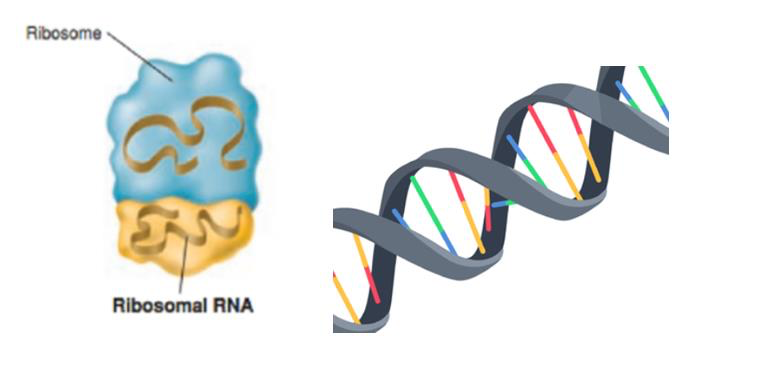
- Name the location within a eukaryotic cell where each molecule would be found. ]]1
- Complete the following table comparing molecules of rRNA and DNA. ]]2
| rRNA | DNA | |
|---|---|---|
| Difference | ||
| Similarity |
- How would DNA differ in prokaryotic and eukaryotic organisms? ]]1
- Adenine and guanine are both classified as purines, double ringed structures of nucleic acids. A cell was found to contain 10% guanine What percentage of thymine would be found in the cell? Explain. ]]2
Question 3
The discovery of a fingerbone in the Densiova cave in Siberia led to the discovery of a new Homo group, the Denisovans. Scientists extracted DNA from the bone and conducted a series of tests to determine where this new group should be placed on the Homo phylogenetic tree.
- Briefly describe the steps that the scientists would have taken to amplify the DNA. ]]3
- The remains found included the fingerbone, skull fragments and teeth. What characteristic of these body parts enabled fossilisation to occur? ]]1
- Describe a molecular technique that could have been used to correctly place the Denisovans on the Homo phylogenetic tree. ]]3
Question 4
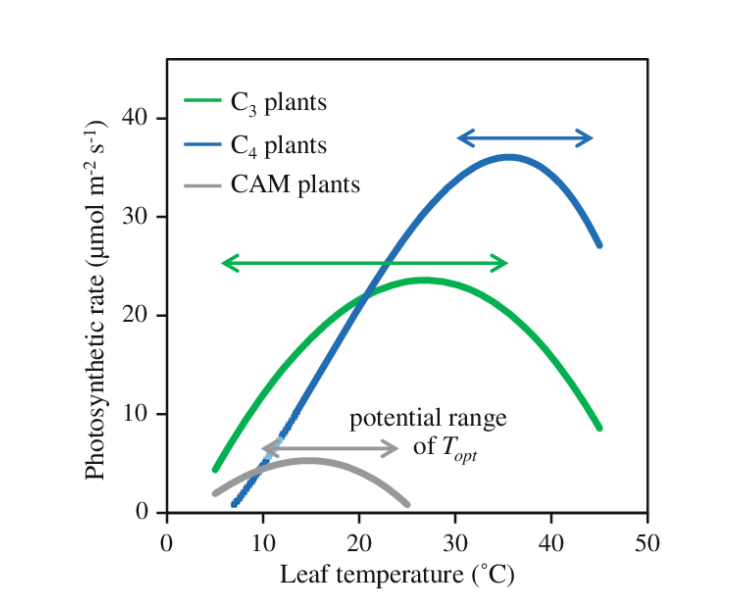
All plants undergo photosynthesis. The chemical pathway may vary, with photosynthetic plants classified as C3, C4 or CAM.
The graph below shows the optimal temperature for C3, C4 and CAM plants, as evident by the photosynthetic rate.
-
How does the photosynthetic rate provide an indication of the optimum temperature? Explain. ]]3
Use data to compare the different optimum temperatures for C3, C4 and CAM plants. ]]3
Account for the change in the graphs following the peak. ]]2
-
How does the data demonstrate that C3, C4 and CAM plants are adapted to survive in particular environments? ]]3
-
Complete the following table for C3 plants, identifying one input and output for each stage. ]]3
| Stage of photosynthesis | Location | Inputs | Outputs |
|---|---|---|---|
| Light Dependent | Oxygen | ||
| Stroma |
Question 5
Marburg virus is in the same family of viruses as Ebola, causing haemorrhaging and fever in those affected. Marburg virus has a mortality rate of 88%. There is not vaccine for the virus, and it has not been able to spread to epidemic levels.
-
Describe the general structure of a virus. ]]1
-
Outline the specific response that would occur in an individual exposed to Marburg virus. ]]4
-
What is an innate response that an infected cell could undertake? ]]2
-
The virus is spread by direct contact between an affected and unaffected individual or any direct contamination from the bodily fluids of an affected person. Describe 2 strategies that could be employed to minimise the potential spread of Marburg virus. ]]2
The map below shows regions in the world where outbreaks have occurred. The dotted lines represent the home range of fruit bats linked to the origin of the disease.
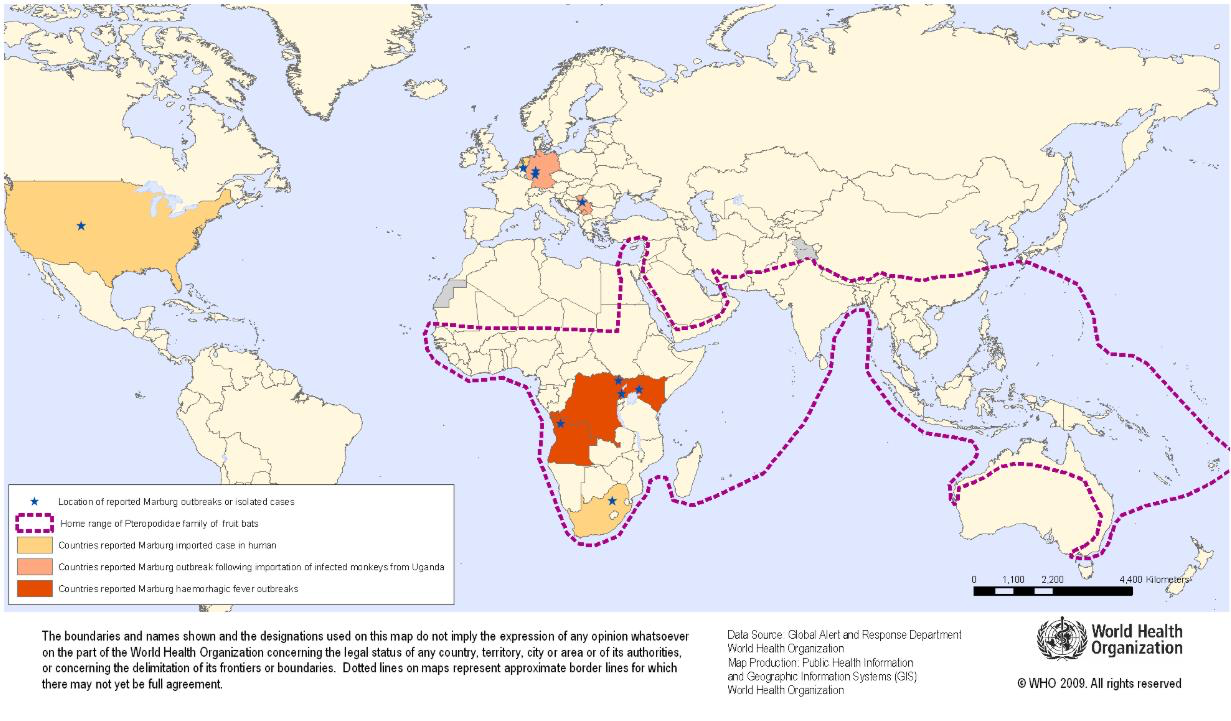
Areas outside of the home range of the fruit bats have shown to have outbreaks following importation of infected monkeys from Uganda.
5. What does this suggest about the transmission of the disease? Explain. ]]3
6. ELISA is one method used to identify if an individual is affected by the Marburg virus following the onset of symptoms. Outline the steps that would occur in the laboratory to identify if an individual had been infected with Marburg virus. ]]3
Question 6
In Gorongosa National Park, Mozambique, a previously rare genetic condition has become more common,asivorypoachingusedtofinanceacivilwarpushedthe elephant speciestothebrinkofextinction. Before the war, about 18.5% of female elephants were naturally tuskless. However, that figure has risen to 33% among elephants born since the early 1990s. Some 90% of Mozambique’s elephant population was slaughtered by fighters on both sides of the civil war that lasted from 1977 to 1992.
Asineye colour and blood type in humans, genes are responsible for whether elephants inherit tusks from their parents. Elephants without tusks were left alone by hunters, leading to an increased likelihood theywould breed and pass on the tuskless trait to their offspring.
Researchers have long suspected that the trait, only seen in females, was linked to the sex of the elephant. After the genomes of tusked and tuskless elephants were sequenced, analysis revealed that the trend was linked to a mutation on the X chromosome that was fatal to males, which did not develop properly in the womb, and dominant in females.
The study has revealed that tusked and tuskless animals eat different plants. https://www.bbc.com/news/world-africa-59008037
- What is the selective pressure acting on the elephants, and how does this effect allele frequencies? ]]2
- What is a biological consequence of the pressure identified in ‘a’? ]]2
- Outline the process by which the allele for tuskless elephants became more prevalent in the Mozambique elephant population. ]]4
Question 7
ELISA is a test that may be used to identify if an individual has HIV. A blood sample is taken and mixed with antigens complementary to antibodies produced by an infected individual in response to the virus.
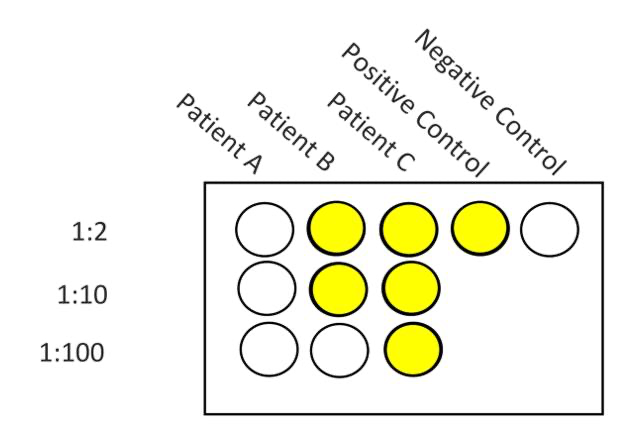
Three patients who had been exposed to HIV were tested against 3 dilution factors: 1:2, 1:10 and 1:100. The dilution factors show how much antigen is in each sample that the patient’s blood is mixed with. A higher dilution factor has less antigens present.
The results for Patient A, Patient B and Patient C are shown below:
- What is the purpose of the positive and negative control? ]]2
- Identify two controlled variables for this test. ]]2
- What do the results suggest about Patient A, B and C’s HIV status? ]]3
- What does the dilution factor suggest about patient B? ]]2
- Suggest a limitation of the test above, and how this could be improved for future tests. ]]2
- A local parliamentarian suggested that those who work in high risk industries, such as the medical field, should be routinely tested for HIV to minimise potential outbreaks and spread, as HIV has no cure. It was proposed that every 6 months they undertake a mandatory blood test. Discuss one ethical and one social issue that may arise from the parliamentarian’s suggestion. ]]4