To evaluate , we must restrict and .
Need to memorize some log identities, see logarithm.
Let , where and , where .
- Find the rule for h where . State the domain and range of h.
Function g has domain R, and it outputs a positive number, which fits in the domain of f, Therefore, function h has domain R.
dom h = R
The rule is .
The range is the same as the range of f.
We know the value that g(x) inputs to f(x), , is always greater than 1.
We know that the graph of has a x-intercept at (1,0).
Therefore
ran h =
- Show that
Let , where .
- Find the rule for .
Let
- State the domain and range of .
Let , where a is a real number. Given ,
- Find values of a such that the graph has exactly one stationary point.
At a stationary point, h’(t) = 0.
Given this equation, we know at least one of or must be zero. Since is always positive, therefore
We are looking for cases where has exactly one stationary point. This means the discriminant is zero.
- Find values of a such that for all real values of t.
Find the range of the function where and .
To find the range, we should graph it.
The structure of this function is new, so we will need to graph it using deductions.
We see that the function has a restriction that , which means . Therefore, there is a vertical asymptote .
Solve .
Notice the restriction which is which is .
Restrictions satisfied.
Umm we got another way to do this.
Notice the restriction which is which is .
The graph of passes through the points and . Find the values of a and b.
The graph of passes through the points and . Find the values of a and b.
Given , evaluate .
Find the range of for .
We need to graph it.
Restrictions are:
Dilation by 9 in x axis.
Reflection in x axis.
Dilation by 4 in y axis.
Reflection in y axis.
Translate 2 left.
Translate 4 up.
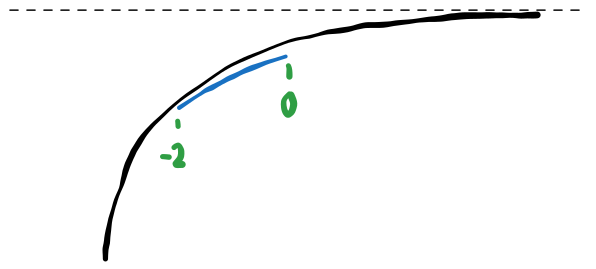
We know what the graph roughly looks like.
We know the asymptote is .
Range can be .
Add domain restrictions now.
Therefore the range is
Simplify .
Let a\in(0,\infty) \backslash {1}and let . Find in the form .
|
|
|
The graph passes through points and . Find the values of a and b.
Solve .
Let
Second impossible.
Given and , express in terms of u.
Solve .
To evaluate , we must restrict and .
Solve .
Let
Find a and b where given it passes through and the asymptote is .
Find a and b where given it passes through and the asymptote is .
|
Given that the graph of the function passes through the points and . Find the values of a and b.