biology exam tssm unit 3 2023
without answers
Reading time: 15 minutes
Writing time: 1 hour and 30 minutes
Section A
25 marks.
Question 1
The purpose of ribosomal RNA (rRNA) is to
- carry genetic information from the nucleus to the ribosome.
- bring a specific amino acid to the ribosome during transcription.
- bind with proteins to form ribosomes.
- catalyse the addition of free nucleotides in a growing mRNA molecule.
Question 2
Operator regions regulate transcription in prokaryotes by
- producing repressor proteins that can bind to the promotor region.
- creating a truncated protein when a protein is not required to be expressed.
- removing introns and splicing exons together.
- providing a binding site for the repressor protein.
Question 3
Gel electrophoresis is a tool used to separate DNA fragments based on their molecular size. Two students ran a gel using the same sample of DNA, the same restriction enzymes, and the same concentration of buffer solution. They both ran the sample for 30 minutes. When they analysed their results, they noticed that in the first students’ sample, the fragments travelled further than the second students’ sample. This would be due to
- the first students’ DNA sample having a stronger negative charge.
- the second student having a stronger current running through the gel.
- the first student having a contaminated sample.
- the second student using the micropipette more accurately than the first student.
Question 4
In photosynthesis, the light dependent reaction splits water into hydrogen ions and oxygen molecules. The hydrogen ions
- bind to NAD+ and move to the matrix.
- bind to NADPH and move to the cristae.
- bind to NADP+ and move to the stroma.
- are enzymes that catalyse carbon fixation.
Question 5
The protein secretory pathway provides a way in which proteins can be exported from the cell. The correct sequence of organelles in which this process occurs is which of the following?
- rough endoplasmic reticulum, ribosome, Golgi body, secretory vesicle, transport vesicle
- ribosome, rough endoplasmic reticulum, secretory vesicle, Golgi body, transport vesicle
- ribosome, rough endoplasmic reticulum, transport vesicle, Golgi body, secretory vesicle
- ribosome, smooth endoplasmic, reticulum, secretory vesicle, Golgi body, transport vesicle
Question 6
A plant in a hot environment with ample access to water displays minimal photorespiration. This plant is most likely to be which of the following?
- C3
- C4
- CAM
- a cactus
Question 7
When creating a recombinant plasmid of insulin, the gene for insulin needs to be inserted within the β galactosidase gene. The reason for this is
- the promotor for the β galactosidase gene allows the insulin to be transcribed.
- itconfersantibioticresistancetotherecombinantplasmid.
- the recognition site for the endonuclease is found in the β galactosidase gene.
- β galactosidase is the binding site for RNA polymerase.
Question 8
In bacteria, the CRISPR CAS 9 complex occurs naturally to protect from re-exposure to a pathogen. The viral DNA is stored as a
- repeat sequence
- spacer sequence
- guide sequence
- PAM site sequence
Question 9
A tRNA anticodon has the 3-nucleotide sequence of UUA. The corresponding sequence on the coding strand of DNA would be which of the following?
- AAT
- TTA
- AAU
- UUA
Question 10
The amino acids tryptophan and methionine are only encoded for by one codon. This means that these amino acids are
- degenerate
- not degenerate
- catalysts
- co-enzymes
Question 11
A competitive inhibitor
- binds to the allosteric site, allowing the rate of reaction to eventually reach the same rate as an uninhibited reaction.
- creates an attenuated protein.
- regulates the rate of transcription by binding to the operator region.
- binds to the active site, and an increase in substrate minimises the impact of the inhibitor.
Question 12
The final H+ acceptor in aerobic respiration is
- oxygen
- FAD+
- NADP+
- NAD+
Question 13
A small sample of DNA was extracted from a fossil and PCR was conducted in a laboratory to amplify the sample. The sample, RNA polymerase, free nucleotides and primers were added.
After 30 minutes it was observed that the amount of DNA in the sample remained unchanged. The most likely explanation for this is
- PCR requires a large sample.
- the incorrect enzyme was added.
- insufficient free nucleotides were added.
- primers are not used in PCR.
Question 14
When considering changes in pH and temperature for an enzyme driven reaction, it is fair to state
- at a pH above and below the optimum, and a temperature below the optimum, the rate of reaction will be low.
- at an optimum pH and temperature, the amount of substrate will remain unchanged.
- at a pH and temperature above the optimum, the rate of reaction will increase.
- at a pH and temperature below the optimum, the rate of reaction will increase.
Question 15
What is the total ATP yield in glycolysis?
- 2
- 4
- 26
- 30
Question 16
The optimal temperatures for polymerase chain reaction in order are
- 95 C, 55 C and 82 C
- 55 C, 95 C and 72 C
- 95 C, 55 C and 72 C
- 82 C, 95 C and 55 C
Question 17
Post translational folding of proteins initially occurs
- at the smooth endoplasmic reticulum.
- at the rough endoplasmic reticulum.
- within the nucleus.
- at the Golgi complex.
Question 18
The production of bioethanol requires a series of steps, one of which is enzymatic hydrolysis. The purpose of enzymatic hydrolysis is to
- produce carbon dioxide.
- directly convert glucose into ethanol.
- break stored sugars into monomers.
- break down chitin into monomers.
Question 19
The labels of the axis on the graph below could be
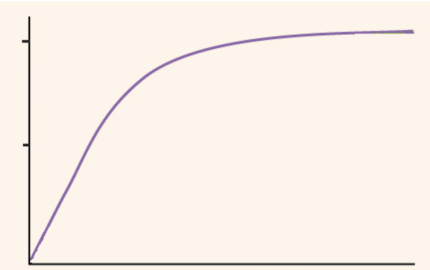
- x: temperature; y: rate of reaction
- x: substrate concentration; y: rate of reaction
- x: rate of reaction; y: pH
- x: enzyme concentration; y: substrate concentration
Question 20
The Cas9 enzyme acts as molecular scissors, cutting through the double strand of DNA. Cas9 cuts at a precise location by
- binding to the target sequence of DNA and cutting 2-5 nucleotides upstream.
- recognising a specific palindromic sequence of DNA and cutting 2-5 nucleotides downstream.
- binding to the tracer sequence of DNA and cutting 2-5 nucleotides downstream.
- binding to the PAM sequence of DNA and cutting 2-5 nucleotides upstream.
Question 21
RNA processing
- removes introns as they are non-coding regions.
- adds a methyl cap to the 3’ end and a poly A tail to the 5’ end to protect the mRNA molecule from degradation when it leaves the nucleus.
- splices introns together.
- converts mRNA to DNA using reverse transcriptase.
Note
The following information relates to questions 22 - 25
A student conducted an experiment to observe the rate of cellular respiration in yeast. Prior to undertaking the experiment, they conducted research and identified that yeast cells have mitochondria, therefore can undergo aerobic respiration.
They added a yeast and sugar solution to a beaker and placed an airtight lid on top. They used an ethanol, carbon dioxide and oxygen probe to measure the changes in the solution over a 30-minute period.
Question 22
After 30 minutes it would be expected that
- ethanol levels would decrease.
- carbondioxidelevelswoulddecrease.
- oxygen levels would increase.
- ethanol levels would increase.
Question 23
After 30 minutes it would be expected that
- aerobic respiration would be occurring.
- anaerobic respiration would have stopped.
- carbon dioxide is being used as an input of aerobic cellular respiration.
- anaerobic respiration would occur.
Question 24
The change in carbon dioxide levels at 15 minutes would be due to
- carbon dioxide being an input in glycolysis.
- carbon dioxide being produced in the Krebs cycle.
- carbon dioxide being an oxygen acceptor in the electron transport chain.
- carbon dioxide being produced in the cristae.
Question 25
A controlled variable in the experiment would be
- the volume of yeast used.
- the oxygen concentration.
- the number of bubbles produced.
- the amount of product produced.
Section B
50 marks.
Question 1
The trp operon contains a group of genes that regulate the production of the amino acid tryptophan in prokaryotes.
- Why is it important for the bacterium to produce tryptophan? ]]2
- What role does the attenuator region of the trp operon have in regulating the rate of tryptophan synthesis? ]]3
- Describe one way in which protein synthesis differs between prokaryotes and eukaryotes. ]]1
- The amino acid code is described as redundant. What is meant by this term? ]]1
Question 2
DNA manipulation involves techniques that can amplify, separate DNA fragments based on molecular size or alter the sequence of nucleotides in an organism.
One technique, creating recombinant plasmids, can introduce DNA from a different species into a bacterial genome.
- What term is used to describe a genetically modified organism that has genetic material from another species? ]]1
- Describe the characteristic of DNA allows for genetic material to be transferred between species? ]]2
- Identify two enzymes used in DNA manipulation and describe their role. ]]4
Question 3
Wheat is the largest grain crop in Australia, with regions in the west of Victoria, including the Wimmera, Central goldfields and Mallee forming part of Australia’s wheat belt.
As a C3 plant, wheat does not have any adaptations to overcome changes in photosynthetic rate that can occur the high temperatures.
- What are the names and locations of the two stages of photosynthesis? ]]2
- In the Wimmera and Mallee regions, temperatures can reach above 30 degrees Celsius. Wheat ready for harvest can be exposed to these high temperatures. Explain, at a molecular level, what is occurring within the chloroplast at high temperatures in the wheat plant. ]]3
- A farmer decided to grow maize, a C4 plant that is a starchier version of a typical sweet corn, in place of wheat. Describe how the process of carbon fixation would differ in the wheat, a C3 plant, and the maize plant at high temperatures? ]]3
- CRISPR Cas9 technologies can be used to increase crop yield. Altering Rubisco to increase its affinity to carbon dioxide is one such option. Outline the process that scientists would undertake to modify rubisco using CRISPR. ]]6
- Referring to the use of CRISPR technology on wheat, outline an ethical issue and describe how an ethical principle should be considered before making decisions. ]]3
Question 4
The production of biofuels, bioethanol and biodiesel, is a growing industry as traditional fossil fuels are becoming scarcer.
- What is the original source of bioethanol? ]]1
- There are 4 stages in the production of bioethanol. Complete the table below to outline the key events that occur at each stage. ]]4
| Stage | Key event |
|---|---|
| Pre-treatment | |
| Enzymatic hydrolysis | |
| Fermentation | |
| Distillation |
- Describe how changes in temperature and pH can alter the rate of bioethanol production. ]]4
Question 5
A biochemical pathway is a series of enzyme-mediated reactions where the product of one reaction is used as the substrate in the next.
Below is an example of a common biochemical pathway found within the body:
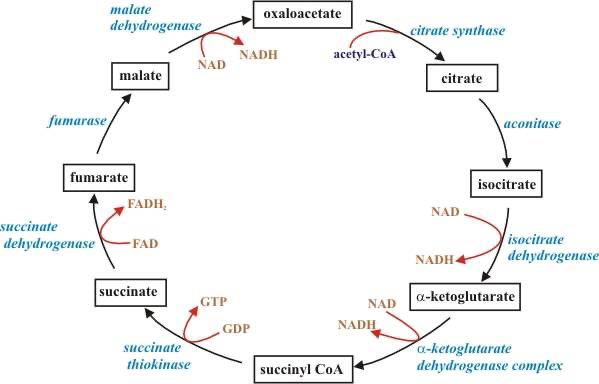
- What is the name of the biochemical pathway shown, and where does it occur? Use evidence to support your response. ]]3
- Inhibitors can alter the rate of an enzyme driven chemical reaction. Describe the action of each type of inhibitor listed below and the effect of the rate of reaction if the concentration of substrate increased.
- a competitive inhibitor: ]]3
- a non-competitive inhibitor: ]]3
- What is the total ATP yield for the biochemical pathway? ]]1