phospholipid
phospholipid bilayer
A phospholipid bilayer is a structure that forms permeable or semi-permeable membranes.
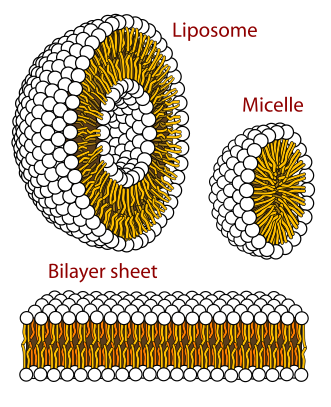
A phospholipid bilayer is made of two layers of phospholipids, forming two sheets where the hydrophilic heads form the outside of the membrane and the hydrophobic tails form the middle of the membrane
Figure: Phospholipids can form a bilayer, and a vesicle.
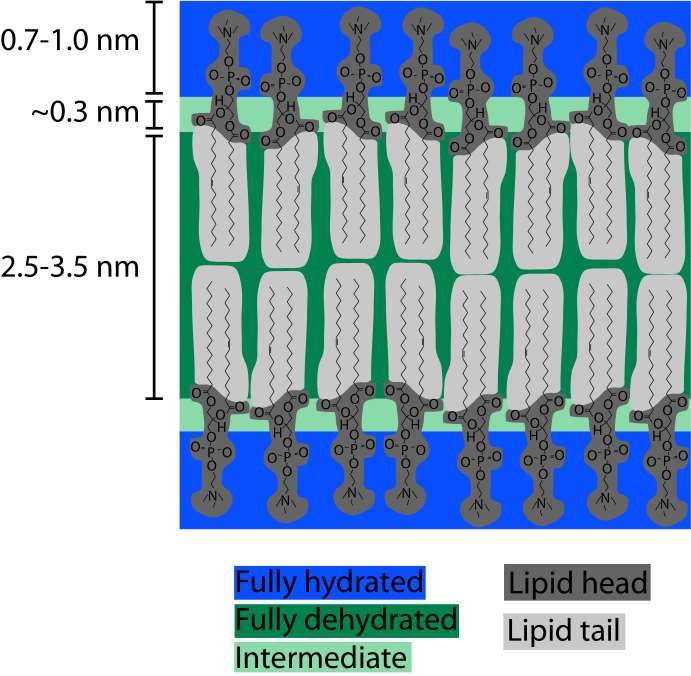
Therefore, phospholipids are the smallest way to separate hydrated environments.
Figure: Hydration levels of a phospholipid bilayer at a small scale. Because the lipids repel water differently across the membrane.
plasma membrane
A plasma membrane is a network of lipids and proteins.
composition
The plasma membrane consists of primarily lipids and proteins. It’s based upon a phospholipid bilayer membrane, and has additional components.
Plasma membranes are selectively permeable. They allow lipid-soluble molecules and some small molecules to permeate the membrane. They repel large, water-soluble molecules and electrically charged ions.
Figure: The fluid mosaic model. In the sea made of the phospholipid bilayer, the proteins float.
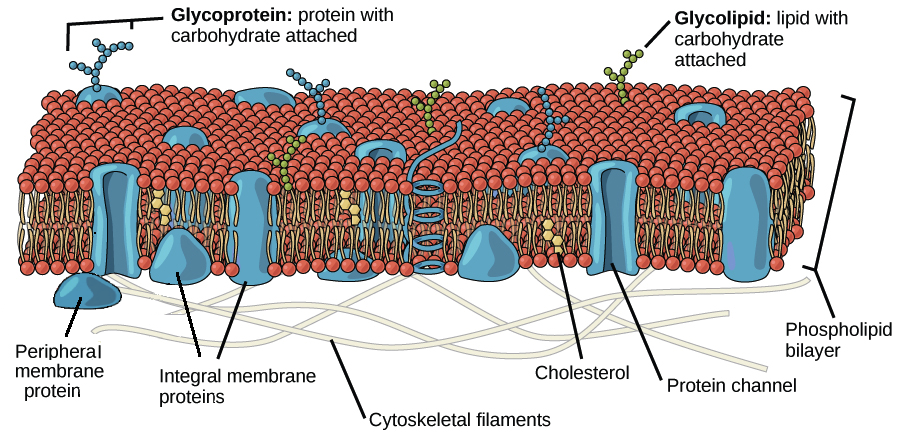
The model for the structure of the plasma membrane is called the fluid mosaic model, showing a mosaic of components that move freely and fluidly in the plane of the membrane, like marshmallows in your hot chocolate.
Proteins are integrated because they can transport things. Proteins that extend across the membrane are protein channels (also transmembrane proteins).