glossary
Cell theory is a scientific theory formed a long time ago and is fairly intuitive with just 3 parts:
- Organisms are made up of cells.
- Cells are the basic unit of all organisms.
- Cells come from pre-existing cells.
It’s no big deal.
The main differences between prokaryotes and eukaryotes is that
- eukaryotes have a nucleus
- eukaryotes are much larger
- eukaryotes divide with mitosis
- almost every organism is made of eukaryotes
see prokaryotic and eukaryotic cells comparison table.
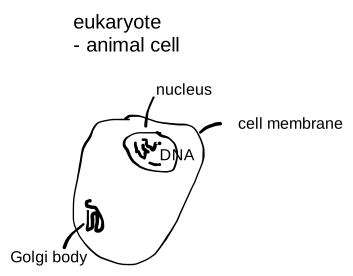
Speaking of eukaryotes, we needa picture of one.
figure: oh well this thing could be much better in the uture
Modern cell theory is a bit different.
- All known living things are made up of one or more cells.
- All living cells arise from pre-existing cells by division.
- The cell is the fundamental unit of structure and function in all living organisms.
- The activity of an organism depends on the total activity of independent cells.
- Energy flow (metabolism and biochemistry) occurs within cells.
- Cells contain DNA which is found specifically in the chromosome and RNA found in the cell nucleus and cytoplasm.
- All cells are basically the same in chemical composition in organisms of similar species.